
Federal Meme Reserve.
Holds nothing. Sells nothing. Takes no side. Tracks what actually happens in memecoin markets and prints the record every day. Every chain that earns a desk is measured by the same method.
The trenches: the high-speed memecoin markets where thousands of tokens launch, trade and die every day.
What the Reserveprinted today.
The Settlement: every wallet that closed a position yesterday, and how many of them came out ahead. Printed at 10:00 UTC. The original is never overwritten; a correction appends to the record.
Reading the chain…
Don't trust it.Open the query.
Every statistic here is derived from public Dune queries under the Reserve's own name, and every instrument links its own. Open it, read the SQL, run it yourself.
The Solana desk.
The Reserve is the institution. The Solana desk is its operation on Solana. LCMM is the currency that desk issues. Its own Board, its own character — measured by the same instruments as any desk the Reserve ever charters.
Called it before it happened.Or didn't.
Three things the Reserve wrote down on 5 September about what its own instruments will read on 6 October, each with the result that proves it wrong. The text was hashed and the hash posted the day it was issued; change one word and it no longer matches. A miss prints at the same size as a hit.
What the trenchesare minting right now.
Every launch on the Solana desk, live off the chain, against a sky running on your local time. Altitude is market cap. A launch that finds buyers keeps climbing; one that doesn't fizzles in its first minute. Gold means it crossed the migration line. Tap one to open it.
The trenches,drawn to scale.
Every coin the trenches are trading right now: size is market cap, colour is the move, and the board never stops moving. Drag it. Throw it. It drifts back. Yesterday's Class is the second tab: every coin that graduated, captured in the 08:00 UTC snapshot.
How hotare the trenches?
One number from three readings — volume, graduation rate and issuance, each against its own seven-day mean. Above 50 the trenches are running hotter than their week. Below 50, colder. Computed by a published formula; nobody's thumb on it. The Reserve reads the dial; it does not set it.
What the trenches didin the last 24 hours.
Tokens issued, tokens dead on the curve, tokens that made it out, the money that moved, how long hands held, and how much of the tape is factories. Read off the chain every morning. Seven-day trace on each.
Green rate,by how long the bag was held.
Six windows, fixed. The same six every morning whatever they say. The Reserve measures how closed positions resolved; it does not claim the holding caused the result.
Reading the chain…
When the trenches cook.
Four-week averages, by hour and weekday, drawn in your own timezone. Hours only, never people.
Who actually got paid.
Realised, closed positions. Sold means counted. What went in, what came out, how long it took — every row checkable on the chain. Wallets, not identities.
Who gets paid to call.
pump.fun pays a pool every day to the people whose callouts moved trades. Paid means counted. Read off the chain from the payer wallet; names as published on pump.fun profiles, matched by wallet. Unnamed wallets stay unnamed.
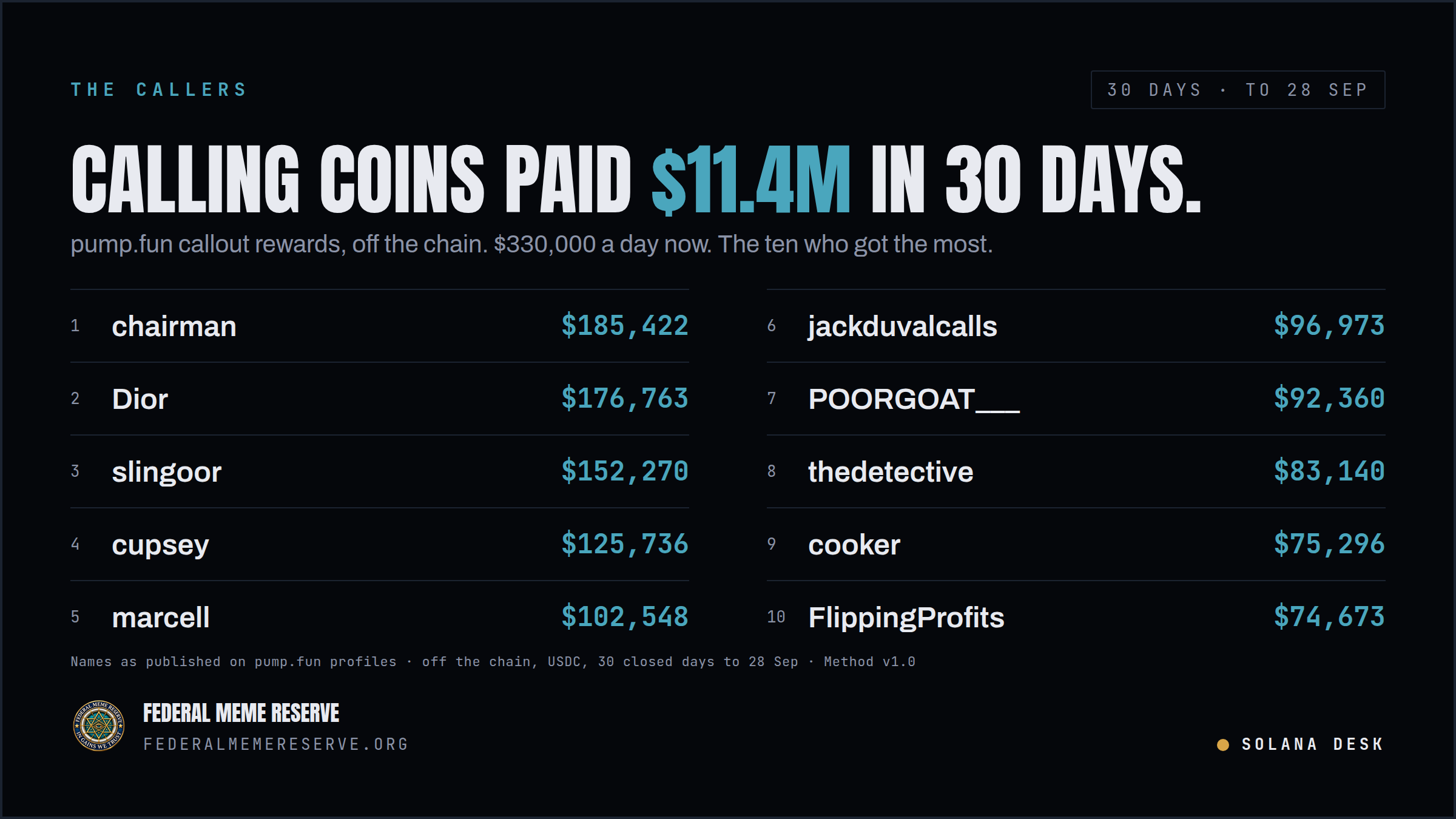
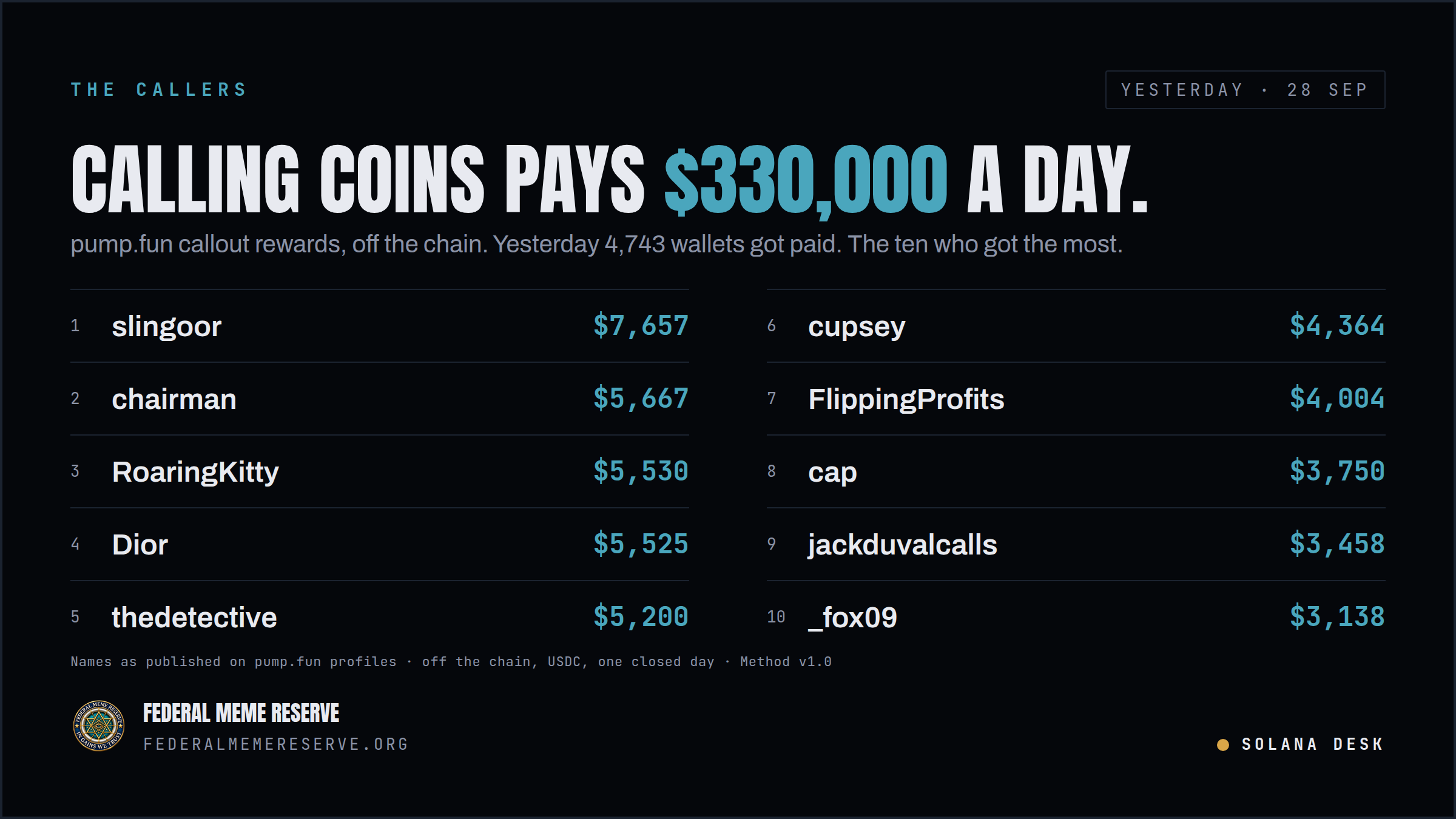
Payer wallet BNrY…RGyh4, USDC, identified 29 Sep 2026 by common-sender test against seven wallets named on pump.fun's callout leaderboard · one batch a day · pool $300K a day to 19 Sep, $1M a day on 1–3 Sep, $330K a day since 20 Sep · queries FMR · callers · payer 30d and FMR · callers · daily · Method v1.0. First print by hand; the daily print joins the archive next.
How the Reserve counts.
Written before the first production query ran. Every definition behind a published number is pre-registered and versioned.
The Settlement counts wallets: every wallet that closed a position that day, once. The Holding Curve counts positions: one wallet, one coin, every buy before every sell, at least three quarters of the bag actually sold. A round-tripper — a wallet that buys the same coin again after selling out — is not a second position. Each print says which it is counting.
Realised profit over a cent. Flats stay in the denominator — so the headline always names the winners. "Only 1 in 4 made money." Never "3 in 4 lost."
<5m · 5m to <30m · 30m to <2h · 2h to <8h · 8h to <24h · 24h and over. Each window includes its lower bound and excludes its upper.
Carries a denominator and a date. Nothing prints on data that hasn't rolled over. Nothing prints that fails the copy gate.
Pass conditions get written before the query runs. The Holding Curve's headline condition went through three pre-registered definitions before its first print. All three are on the record.
Their own post. The original stays up. A quiet fix is worse than the mistake.